Hired and Non-Owned Auto Insurance: What It Covers When Staff Deliver in Their Own Cars
Hired and non-owned auto insurance explained for NYC caterers, bakeries, and florists: what HNOA covers, what it doesn't, how it works with an employee's own policy, and when you need it.

Hired and non-owned auto insurance (HNOA) is business liability coverage for accidents that happen while someone drives a car your business doesn’t own for work. That includes an employee using their own car to deliver a cake, or a rental van you pick up for a busy weekend. It pays for injuries and damage to other people. It doesn’t pay to fix the car your employee was driving.
For small food and flower businesses in New York, this is a common gap. The business has no company car, so it has no commercial auto policy. But staff run deliveries and errands in their own cars every week. If one trip ends in a bad crash, the business can be pulled into the claim.
This guide is general information, not insurance or legal advice. Talk to a licensed broker about your business.
Key takeaways
- HNOA covers liability: bodily injury and property damage your business causes to others while someone drives a hired or non-owned car for work.
- It does not cover damage to the car being driven, or injuries to your own staff.
- For employees’ own cars, it sits above their personal policy and helps when a claim is bigger than their limits.
- New York’s minimum personal limits are low: $25,000 for one person’s injuries and $10,000 for property damage.
- Clients may ask for it. Office buildings and event venues often list auto coverage on their insurance requirements.
What Is Hired and Non-Owned Auto Insurance?
HNOA is two coverages sold together, usually as an add-on to a general liability or business owner’s policy:
- Hired auto coverage applies to vehicles your business rents, leases, or borrows, such as a rented cargo van for a large catering order.
- Non-owned auto coverage applies to vehicles your business doesn’t own, lease, or rent, which mostly means employees’ personal cars used for work.
The Hartford describes non-owned coverage as protection that “provides extra coverage over the employee’s personal auto policy for bodily injury and property damage liability” (The Hartford). In other words, the employee’s own insurance pays first. HNOA steps in when the claim goes past their limits, or when the claim is aimed at your business.
What HNOA Covers and What It Doesn’t
| Covered | Not covered |
|---|---|
| Injuries to other drivers, passengers, and pedestrians | Damage to the employee’s car or the rental |
| Damage to other people’s cars and property | Injuries to you or your employees |
| Legal defense if your business is sued | Personal errands, such as a driver’s own shopping |
| Accidents in rented, leased, or borrowed vehicles used for work | Vehicles your business owns, which need a commercial auto policy |
Injuries to your staff are a workers’ compensation matter, not an auto one. The Hartford notes that HNOA “does not cover injuries that happen to you or your staff.”
In New York, workers’ compensation is the insurance that covers employees who are hurt on the job, and the state sets which employers must carry it (NYS Workers’ Compensation Board).
Damage to the car itself stays with the car’s own policy. Collision coverage is the part of a car policy that pays to repair the car after a crash. If an employee’s car is damaged on a delivery, their own collision coverage, if they have it, is what pays.
Why It Matters in New York
Every car in New York must carry liability insurance, but the required minimums are low next to what a serious crash can cost.
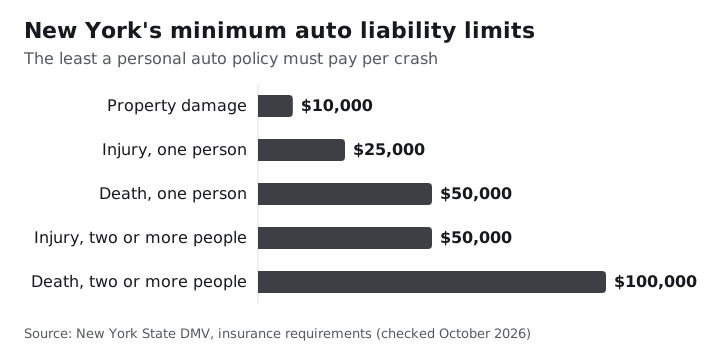
| What the policy pays | New York minimum |
|---|---|
| Property damage, one crash | $10,000 |
| Bodily injury, one person | $25,000 |
| Death, one person | $50,000 |
| Bodily injury, two or more people | $50,000 |
| Death, two or more people | $100,000 |
These figures come from the New York State DMV. Some drivers carry only the minimum. Say an employee with minimum limits causes a crash on a delivery. Damages above those limits can lead the injured party to look at the business that sent them. Non-owned coverage is there for that case.
Personal policies also differ in how they treat driving for work. Some personal auto policies exclude certain paid delivery activity. Ask employees who drive for you to check their own policy, and ask your broker how your HNOA responds if their insurer denies a claim.
Who Needs Hired and Non-Owned Auto Insurance
You likely need HNOA if any of these are true:
- Employees use their own cars for deliveries, supply runs, or client visits.
- You rent vans or trucks for busy days, such as holidays or large events.
- You borrow a vehicle from a friend or partner business for work.
- A client or building requires it before you can deliver or work on site.
For example, consider a Brooklyn bakery where the manager drops off a wedding cake in their own SUV every Saturday. Or a florist who rents a van for Mother’s Day week. Or a caterer whose assistant picks up ice and rentals in a personal car. Each is a business trip in a car the business doesn’t own.
HNOA is not a substitute for a commercial auto policy if your business owns its vehicles. Company-owned vans need their own coverage.
What It Costs
There’s no standard price. Insurers base it on a few factors:
- How many employees drive for work, and how often.
- Their driving records.
- What the trips involve, such as short local deliveries or long runs.
- The limits you choose.
HNOA is usually added to a policy you already have, such as general liability, rather than bought on its own. Get quotes from at least two brokers and ask them to explain the limits.
Reimbursing Employees for Mileage
If employees drive their own cars for work, decide how you’ll pay them back. Many businesses use the IRS standard mileage rate. For 2026, it is 72.5 cents per mile for January through June and 76 cents per mile from July 1 through December 31 (IRS).
The IRS bases the rate on a yearly study of the fixed and variable costs of operating a car (IRS). It doesn’t replace your business’s liability coverage.
HNOA and Your Certificate of Insurance
Office buildings, venues, and corporate clients often ask for a certificate of insurance before you deliver. Some ask specifically for “hired and non-owned auto” coverage, especially when your staff will drive onto the property or use the loading dock.
Our guide to certificates of insurance explains how to read a request and get the right certificate quickly.
How to Reduce the Risk
Insurance pays after a crash. A few habits help prevent one:
- Keep a list of who drives for work, with copies of their license and insurance card.
- Check driving records for anyone who drives regularly.
- Set clear rules: no phone use while driving, and no personal stops during deliveries.
- Plan routes and parking so drivers aren’t rushing or circling. Our guide to commercial vehicle parking in NYC covers loading zones.
- Use a courier for peak days, so staff aren’t driving long routes in their own cars.
Businesses that hand off deliveries to a courier service shift much of the driving risk to the courier and its insurance. Ask any courier you use for its own certificate of insurance.
Frequently Asked Questions
What does hired and non-owned auto insurance mean?
It is business liability coverage for crashes in cars your business doesn’t own, such as rentals or staff cars used for work. It pays for injuries and damage to others.
Does hired and non-owned auto insurance cover damage to the employee’s car?
No. HNOA covers liability to other people. Damage to the employee’s own car is handled by their personal policy, if they carry collision coverage.
Do I need HNOA if my employees have their own car insurance?
Their insurance pays first. HNOA protects your business when a claim exceeds their limits or names your business. In New York, many drivers carry only the state minimum, which is $25,000 for one person’s injuries.
Is hired and non-owned auto the same as commercial auto insurance?
No. Commercial auto insurance covers vehicles your business owns. HNOA covers vehicles it doesn’t own. It’s often added to a general liability or business owner’s policy.
Does HNOA cover employee injuries?
No. Injuries to your own employees are covered by workers’ compensation.
Who needs hired and non-owned auto insurance?
Any business whose staff drive personal, rented, or borrowed cars for work. That includes caterers, bakeries, florists, and other businesses that deliver without a company vehicle.
The Bottom Line
If your staff deliver in their own cars, your business has driving risk even without a company vehicle. Hired and non-owned auto insurance covers the liability side of that risk. Ask your broker about it, and keep good records of who drives for you. Want to keep staff out of their cars? See how catering delivery, bakery delivery, and florist delivery work in NYC, or price a delivery route.