How to Start a Catering Business in NYC: Permits, Kitchens, and First Clients
How to start a catering business in New York City: the Health Department permit, Food Protection Certificate, sales tax registration, where to cook, how to price, and how to deliver on time.
To start a catering business in New York City, you need four things. You need a licensed commercial kitchen and a Food Service Establishment permit from the NYC Health Department. The person who runs the kitchen needs a Food Protection Certificate, and the business needs a Certificate of Authority to collect sales tax. Then you need a menu that travels well and a reliable way to get it to offices and events on time.
That sounds like a lot, but each step is a known process with a known fee. This guide walks through them in order, with the NYC details that general guides skip.
This guide is general information, not legal advice. Fees and rules change, so confirm each step with the agency linked.
Key takeaways
- You can’t cater from a home kitchen in NYC. New York’s home processor rules exclude food that needs refrigeration, which covers most catering.
- The main permit is the Health Department’s Food Service Establishment permit. It costs $280 a year for most businesses.
- A supervisor needs a Food Protection Certificate. The online course is free; the exam is $24.
- Register for sales tax before your first sale. Catered food and service charges are taxable in New York.
- Delivery is part of the product. A lunch that arrives late to a Midtown office is a lost account.
Step 1: Decide What Kind of Caterer You Are
Catering covers very different businesses. Pick one to start, because it decides your kitchen, staff, and pricing.
| Model | What you sell | What it needs |
|---|---|---|
| Drop-off catering | Trays or boxed meals delivered ready to serve | Kitchen time, packaging, reliable delivery |
| Office lunch programs | Recurring orders for the same companies | Consistent menus, invoicing, early cutoffs |
| Full-service events | Food plus staff, setup, and service on site | Event staff, rentals, liability coverage |
| Specialty catering | One focus, such as kosher, vegan, or a cuisine | A clear niche and the right supplier list |
Drop-off catering is the usual starting point. It is food delivered ready to eat, with no staff staying on site. It needs the least equipment and the fewest people, and offices order it every week.
Step 2: Understand Why You Can’t Cook at Home
Most new caterers ask whether they can start in their own kitchen. In New York, the answer is almost always no.
New York’s home processor registration lets people sell some shelf-stable foods made at home, such as breads, cookies, and jams. But the state says “any finished food product that requires refrigeration is prohibited” for home processors (NYS Department of Agriculture and Markets). Salads, cooked proteins, and dairy-based dishes all need refrigeration, so they are out.
Our guide to New York’s cottage food law covers what a home kitchen can sell. For catering, plan on a commercial kitchen from day one.
Step 3: Find a Commercial Kitchen
You don’t need to build a kitchen to start. Most new caterers rent one.
- Shared kitchens rent licensed space by the shift or the hour. They are the cheapest way to start.
- A restaurant’s off-hours. Some restaurants rent their kitchen overnight or on closed days.
- Your own space makes sense once orders are steady enough to cover the rent.
A shared kitchen is a licensed commercial kitchen that several food businesses use on a schedule. In NYC, the kitchen operator holds a Non-Retail Food Processing Establishment permit. The operator’s permit doesn’t cover you. The city says anyone selling ready-to-eat food at catered events still needs a Food Protection Certificate and their own Food Service Establishment permit (NYC Business).
When you tour a kitchen, look past the stoves. Ask about:
- Cold storage. Catering means holding finished trays before pickup.
- Loading access. Where can a van stop, and how far is it from the walk-in?
- Shift times. Can you cook early enough for a 7 a.m. breakfast drop?
- Neighborhood. A kitchen in Brooklyn or Long Island City can reach Midtown quickly before the morning rush.
Step 4: Get the Health Department Permit
The Food Service Establishment permit is the permit most people mean when they search for a “catering license” in NYC. It is issued by the Department of Health and Mental Hygiene (DOHMH). According to NYC Business:
- Fee: $280 a year for most food service establishments, plus $25 if you make frozen desserts.
- Before you apply: a Food Protection Certificate (or course registration), a Certificate of Authority to collect sales tax, and proof of workers’ compensation and disability insurance listing DOHMH as certificate holder.
- No employees? You submit Form CE-200 from the Workers’ Compensation Board instead.
- Timing: you may open 22 days after you apply, even without a pre-permit inspection.
- Inspections: expect an unannounced visit after you open and an unscheduled inspection every year.
- Renewal: the permit expires one year from the end of the month you applied.
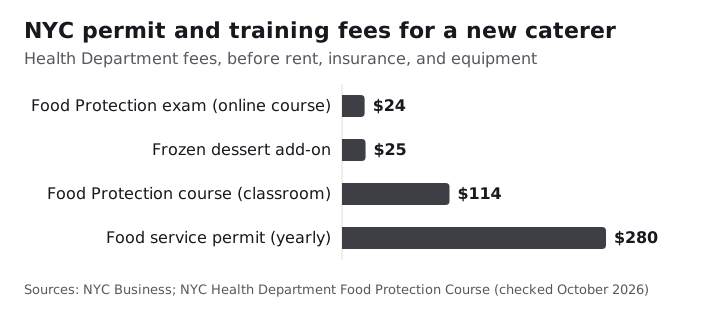
These fees are small next to rent and insurance. The time is the bigger cost: the Certificate of Authority alone “can take weeks to obtain,” the city warns, so start it first.
Step 5: Get Your Food Protection Certificate
A Food Protection Certificate is the NYC Health Department’s food safety credential for supervisors. A certified supervisor must be on site whenever the kitchen operates.
You have two ways to get it (NYC Health Department):
| Option | Cost | How it works |
|---|---|---|
| Online course | Free course, $24 exam | 15 self-paced lessons, then an in-person final exam |
| Classroom course | $114 | Course and final exam together |
Pass the exam and you get a temporary certificate right away. Plan this before you book kitchen time, since the permit application asks for it.
Step 6: Register for Sales Tax
You must register with New York State before you make your first sale. The Tax Department says every person who sells taxable goods or services must register, including home-based and part-time sellers (NYS Tax Department). You apply online through New York Business Express.
Catering is taxable. The state’s caterer guidance says a caterer’s charges for food, drinks, and services for an event are subject to sales tax (NYS Tax Department). A service charge that isn’t labeled as a gratuity is taxable too. In New York City, the combined rate is 8.875% (Publication 718).
Build tax into your quotes from the start. Customers notice when a $1,000 order turns into $1,089 at checkout.
Step 7: Set Up Insurance
You’ll need insurance before most kitchens, venues, and office buildings will let you in.
- General liability for injuries and property damage at events.
- Product liability for foodborne illness claims.
- Workers’ compensation and disability, which the permit requires.
- Commercial auto, or hired and non-owned auto insurance if staff deliver in their own cars.
Office buildings and event venues will ask for a certificate of insurance before you deliver. Our guide to certificates of insurance explains what they look for and how to get one quickly.
Step 8: Price Your Menu
Price per person, not per tray. Office managers budget per head, and per-person pricing makes your quotes easy to compare.
A simple way to build a per-person price:
- Add up food and packaging cost per guest.
- Add labor for prep, packing, and setup.
- Add delivery cost, including parking and the return trip.
- Add overhead: kitchen rent, insurance, and permits spread across your orders.
- Add your margin.
For example, consider a 25-person office lunch. If food and packaging cost $9 a head and labor adds $4, the delivery and overhead share has to be covered before profit. Set a minimum order so a small order doesn’t cost more to deliver than it earns.
Source your produce well, too. Many NYC caterers buy at the Hunts Point Produce Market in the Bronx, which can cut ingredient costs on large orders.
Step 9: Plan Delivery Before You Book Your First Event
In NYC, the food is only half the job. Getting it into the building on time is the other half.
- Know the curb rules. Most Midtown blocks don’t allow standing. Our guide to no standing vs. no parking explains what a driver can and can’t do.
- Plan for freight elevators. Many office towers send deliveries through the service entrance. Read our guide to freight elevators before your first Manhattan drop.
- Build in buffer time. Aim to arrive 20 to 30 minutes before the meal starts.
- Keep food at safe temperatures the whole way, with insulated carriers.
Many caterers deliver regular orders themselves and use a courier for overflow, long trips, and days when two events overlap.
Step 10: Win Your First Clients
Start with the clients who order often:
- Office managers and executive assistants, who place recurring lunch orders.
- Event planners and venues, who keep lists of preferred caterers.
- Catering marketplaces, which help new offices find you.
- Past customers, who are the cheapest to win back.
Make ordering easy. Publish a short menu with per-person prices, minimums, lead times, and your delivery area. Then follow up after every order to turn one event into a standing account.
Frequently Asked Questions
Do you need a license to start a catering business in NYC?
Yes. Most caterers need a Food Service Establishment permit from the NYC Health Department. The supervisor needs a Food Protection Certificate, and the business needs a Certificate of Authority to collect sales tax. The permit costs $280 a year for most businesses.
Can I start a catering business from home in New York?
Generally no. New York’s home processor rules don’t allow food that needs refrigeration, which includes most catering dishes. You’ll need a licensed commercial kitchen, such as a shared kitchen rented by the shift.
How much does it cost to start a catering business in NYC?
The permit and training fees are a few hundred dollars. The larger costs are kitchen rent, insurance, packaging, and delivery equipment. Start with drop-off catering in a shared kitchen to keep startup costs low.
How long does it take to get a food permit in NYC?
You can open 22 days after you submit the permit application. But the Certificate of Authority for sales tax can take weeks, so apply for it first.
Is catering taxable in New York?
Yes. New York taxes a caterer’s charges for food, drinks, and event services. Service charges not labeled as gratuities are also taxable. The combined rate in New York City is 8.875%.
How do caterers deliver in Manhattan?
They plan around curb rules, building loading docks, and freight elevators, and they arrive early. Many use a courier for busy days so a second event doesn’t wait on the first van.
The Bottom Line
Starting a catering business in NYC comes down to a commercial kitchen, one Health Department permit, a Food Protection Certificate, and sales tax registration. After that, growth depends on food that travels well and arrives on time. When your own van can’t cover every order, see how catering delivery in NYC works, or price a delivery route for your next event.