How to Start a Flower Business in NYC: From First Arrangement to Steady Orders
How to start a flower business in New York City: choosing a model, registering for sales tax, buying wholesale in the Flower District, pricing arrangements, and planning delivery for holiday peaks.
To start a flower business in NYC, pick one model to begin with (events, a studio, a storefront, or corporate accounts), register the business and get a Certificate of Authority to collect sales tax, set up a wholesale buying routine in the Flower District, price every arrangement from its cost, and plan delivery before your first holiday rush. Most of what makes a flower business work is buying well and delivering on time.
You don’t need a storefront to start. Many NYC florists begin with weddings and events, or from a small studio, and add a shop only once orders are steady.
Key takeaways
- Choose one model first. Event, studio, storefront, and corporate florists run very different businesses.
- Register for sales tax before your first sale, then use a resale certificate to buy flowers wholesale.
- Buy in the Flower District on West 28th Street, early in the morning, from wholesalers who sell to the trade.
- Price from cost. Add up flowers, greens, vase, and labor, then add your margin.
- Delivery peaks are your biggest test. Plan drivers and routes for Valentine’s Day and Mother’s Day weeks ahead.
Step 1: Choose Your Flower Business Model
| Model | How you make money | What it needs |
|---|---|---|
| Event and wedding florist | Large, planned orders for weddings, galas, and corporate events | A portfolio, a studio or rented workspace, setup help |
| Studio or online florist | Bouquets and arrangements ordered online and delivered | A website, a cooler, reliable delivery |
| Retail storefront | Walk-in sales plus delivery orders | A lease, foot traffic, daily staffing |
| Corporate accounts | Weekly lobby, office, and restaurant arrangements | Consistent quality, a set delivery route |
An event florist is a florist who designs flowers for specific events rather than selling day to day. It’s a common starting point because each order is large and booked weeks ahead, so you buy only what you’ve already sold.
Corporate accounts are steady. A hotel lobby, restaurant, or office that wants fresh arrangements every Monday gives you predictable buying and a fixed route.
Step 2: Know the Work and the Market
Floral design is a hands-on trade, and many florists work for themselves. In the U.S., there were 45,200 floral designer jobs in 2025, with a median pay of $37,360 a year (BLS).
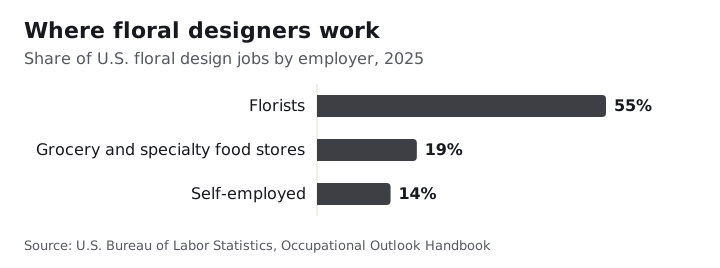
The same BLS data show where floral designers work: 55% at florists, 19% at grocery and specialty food stores, and 14% self-employed (BLS). The agency projects floral designer jobs to fall 6% from 2025 to 2035 (BLS). Grocery stores sell a lot of simple bouquets, so independent florists win by offering design, service, and delivery that a supermarket can’t.
If you haven’t worked in a shop, spend a season working for an established florist first. You’ll learn processing, care, and how a holiday week really runs.
Step 3: Register Your Business and Sales Tax
Start with the basics:
- Choose a business structure, such as a sole proprietorship or LLC, and register it.
- Get an EIN from the IRS if you’ll hire staff or form an LLC.
- Open a business bank account.
- Register for sales tax.
New York requires every business that sells taxable goods to register before it begins selling, including home-based sellers (NYS Tax Department). Flowers are tangible goods, and New York taxes sales of tangible goods unless a specific exemption applies (NYS Tax Department). You’ll register through New York Business Express. A Certificate of Authority is the document New York issues when you register, and it lets you collect sales tax.
Once you have it, you can give wholesalers a resale certificate. A resale certificate is a form, New York’s Form ST-120, that lets you buy flowers you’ll resell without paying sales tax on them. You then collect tax from your customers instead.
If you work from home, check that your space and any pickups fit NYC zoning rules for home businesses. NYC Business has a step-by-step tool for the permits your location needs.
Step 4: Set Up Your Studio
You don’t need much to begin, but a few things aren’t optional:
- A cooler. Cut flowers last far longer when stored cold. Start with a reach-in floral cooler.
- Work tables and a sink for processing stems.
- Buckets, shears, and floral supplies.
- Vases and packaging in a few standard sizes.
- Space to stage deliveries, so finished orders don’t sit in the way of new work.
In Manhattan, rent is the biggest cost. Many new florists rent shared studio space or a small storefront outside the busiest blocks and deliver into Midtown.
Step 5: Learn to Buy Wholesale
Most NYC florists buy at the Flower District, the cluster of wholesalers on West 28th Street between Sixth and Seventh Avenues. It opens early, before dawn, and the best stems sell first.
Our NYC Flower District guide covers hours, how wholesalers work, and what to bring. A few rules for new buyers:
- Bring your resale certificate to every wholesaler you buy from.
- Buy for orders, not for stock. Unsold flowers are a loss within days.
- Build relationships. Regular buyers get first pick and hear about good lots.
- Pre-order for holidays and events. Roses for Valentine’s Day are booked weeks ahead.
Some wholesalers also deliver, which helps on mornings you can’t leave the studio.
Step 6: Price Every Arrangement From Its Cost
Underpricing is the most common mistake new florists make. Every arrangement should have a written recipe and a price built from it.
- List every stem in the recipe and its wholesale cost.
- Add greens, the vase, and packaging.
- Add labor for design time.
- Add delivery as a separate line or build it into the price.
- Apply your markup so the price covers overhead and profit.
For example, suppose an arrangement uses $30 of flowers and greens and a $10 vase. If you don’t price in your design time, the cooler, and the stems that wilt before they sell, the order can lose money even at $60. Write the recipe down so you can price it the same way every time.
Step 7: Plan Delivery Before Your First Holiday
Delivery is part of what customers pay for, and in NYC it’s the hardest part to scale.
- Valentine’s Day and Mother’s Day bring a flood of same-day orders. Plan drivers and routes weeks ahead.
- Use the right vehicle. Tall arrangements need to ride upright and steady.
- Plan for buildings. Office towers may send you to a freight entrance. Our guide to freight elevators explains what to expect.
- Take a photo at delivery as proof the arrangement arrived intact.
- Cover your staff’s driving. If employees deliver in their own cars, look at hired and non-owned auto insurance.
High-value event work may need careful handling and setup on site. Our guide to white glove delivery explains that service level.
Step 8: Find Your First Customers
- Wedding and event planners, who refer florists they trust.
- Venues, hotels, and restaurants, which need weekly arrangements.
- Local businesses that send flowers to clients and staff.
- Your own neighborhood, through a simple website, a Google Business Profile, and Instagram.
Photograph every arrangement before it leaves. Your photos are your portfolio.
Frequently Asked Questions
How do I start a flower business from home?
Start with event or online orders, register your business and sales tax, buy flowers wholesale with a resale certificate, and set up a cooler and work area. Check NYC zoning rules for home businesses before customers pick up at your door.
Do I need a license to sell flowers in New York?
You’ll need to register your business and get a Certificate of Authority to collect sales tax before your first sale. Use the NYC Business step-by-step tool to check anything else your location requires.
Where do NYC florists buy flowers?
Most buy from wholesalers in the Flower District on West 28th Street in Manhattan. Some wholesalers also deliver to regular accounts.
How much does it cost to start a flower business?
It depends on the model. A studio or event florist can start with a cooler, supplies, and a website. A storefront adds rent, build-out, and staff, which raise the cost considerably.
How do I price flower arrangements?
Add up the wholesale cost of every stem, plus greens, the vase, and packaging. Then add labor, delivery, and a markup that covers overhead and profit.
How do florists handle delivery on Valentine’s Day?
They pre-order flowers, build designs ahead, plan routes in advance, and add drivers or a courier for the peak days.
The Bottom Line
A flower business in NYC runs on three things: buying well, pricing every arrangement from its cost, and delivering on time. Start with one model, keep your buying tied to real orders, and plan your holiday delivery capacity early. When your own deliveries can’t keep up, see how florist delivery in NYC works, or price a delivery route for your next busy week.